Top of page
Skip to main content
Main content

Econ and AI Applicants


Emory’s Master of Science in Economics and Artificial Intelligence sits at the intersection of computer science and economics. Offered jointly by the two departments, the program trains students in machine learning, econometrics, and computational methods, then pairs that technical foundation with economic theory and policy analysis.

You'll learn from faculty who are shaping their fields, not just teaching from them. Our economists are regularly called on by NPR, CNN, ABC, NBC, CBS, and Fox News, and several hold research affiliations with NBER. One professor is a Fellow of the Royal Economic Society, the field's highest honor.

On the computer science side, faculty include the creator of PVM, a foundational tool in distributed computing, along with recent honors like the ACM SIGKDD Rising Star Award, a Fellowship in the American Association for the Advancement of Science, and best-paper wins at IEEE ICDM and the American Economic Review.

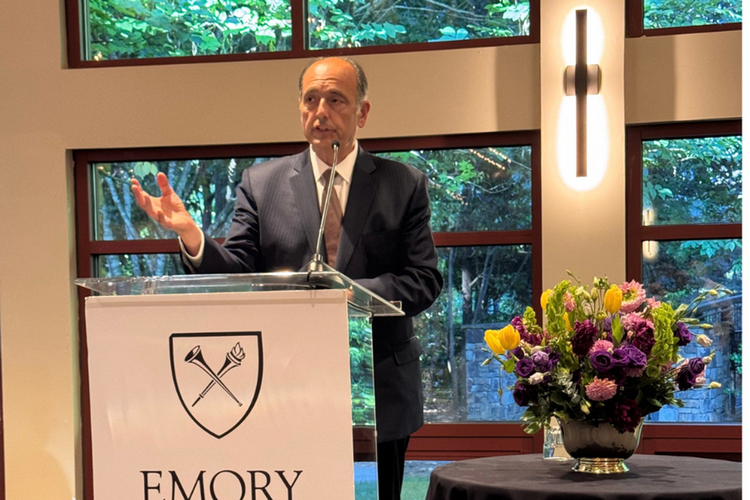
That expertise extends beyond the classroom through direct partnerships with the Federal Reserve Bank of Atlanta and Goizueta Business School, giving students access to real economic and financial data problems. Atlanta adds another advantage: the city hosts the Fed's Sixth District, a fast-growing fintech and tech sector, and corporate headquarters like Delta, Coca-Cola, and Home Depot, all just minutes from campus.

STEM-Designated Degree

This program is STEM-designated (CIP code 30.3901), which qualifies international graduates for a 24-month STEM OPT extension on top of the standard 12-month OPT period. That's up to three years of work authorization in the U.S. after graduation.

Curriculum

The program is completed in one year across three terms, blending required core courses in AI and economics with electives and a two-course capstone. Courses are taught in person by our Emory faculty.
CourseDescription 
CS 534Machine Learning
CS 557Artificial Intelligence
Econ 524Big Data Econometrics
Econ 525Computer Programming & Data Management in Economics 
CategoryOptions
2 CS Electives
  • Natural Language Processing
  • Neural Networks & Deep Learning
  • Human-AI Interaction
  • Social & Ethical Issues in Computing
1 Econ Elective
  • Digital Assets & Blockchain
  • Internet Economics
  • Algorithmic Game Theory
  • Computational Macroeconomics
2 Capstone Courses 
  • Advanced Computing Methods in Economics
  • AI and Economic Policy 
  • Emerging Technologies & Innovation Policy
Professional Development Course
Practicum Experience 

Careers

Graduates are prepared for roles that combine technical AI skill with economic reasoning, in high-tech industries, financial services, consulting, and public policy. Students seeking extra quantitative training before a PhD can also use the program as a bridge into doctoral study in economics, computer science, business, or public policy.

In addition to support from the LGS Professional Development and Career Planning (PDCP) office, students in this program received tailored support from Keith Robinson, Director of Professionalism and Placement and Natima S. Fisher, Assistant Director and Career Coach. Both bring years of industry experience to help students articulate their learning outcomes in ways that help them stand out in today's job market. 

Possible Career Paths

All figures are from the U.S. Bureau of Labor Statistics, 2025 data, 2025–35 projections.

Admissions Requirements

Applicants must have earned an undergraduate Bachelor’s degree at an accredited institution by the time they enroll in the MS program. Students currently enrolled in undergraduate coursework who anticipate graduating by the time the MS program begins may apply.

Applicants must have a minimum cumulative grade point average of at least 3.0 on a 4.0 scale. A GPA of at least 3.5 is preferred. 

An undergraduate major in economics is not required, however, we require applicants to have completed the following foundational courses:
Foundational Quantitative Courses
  • Calculus (derivatives and integrals)
  • Probability & Statistics or Mathematical Statistics

Foundational Economics Courses 

  • Principles of Microeconomics and Intermediate Microeconomics
  • Principles of Macroeconomics and Intermediate Microeconomics
  • Econometrics 


Working knowledge of programming in a high level language is required.

While we do not have a specific set of courses that applicants must complete, our curriculum requires that you have experience with foundational quantitative and computer science concepts. 

The courses provided here serve as a guide for you to evaluate your preparation. 

Foundational Quantitative Courses
  • Linear Algebra (Highly suggested)
  • Discrete structures (Highly suggested)

Foundational Computer Science Courses 

  • Algorithms (Highly suggested)
  • Data structures (Highly suggested)
  • Intro to programming (Highly suggested)
  • Databases
  • Systems
  • Computer Architecture

International students must demonstrate English Proficiency. Details on this can be found in the application section below.

APPLYING TO THE EMORY ECON AND AI MS PROGRAM

Admission to the Economics and AI MS program is coordinated by the Emory Laney Graduate School and requires the following:

A one-page statement explaining the reasons you are interested in attending the Economics and AI MS program at Emory University.

  • The statement should be well-organized, concise, and completely free of grammar, punctuation, and spelling errors.

A document listing relevant experiences and accomplishments, such as internships, awards, and research experiences, that you believe will strengthen your application.
  • If you lack a strong academic preparation for CS coursework, provide evidence in your statement of purpose and resume/CV

Unofficial copies of transcripts from each post-secondary institution you have attended, including your current one.

  • Must be in English. 
  • While we do not require official transcripts as part of the application process. Official transcripts need to be submitted only if and when you are offered and accept admission.


Two letter of recommendation from an instructor or professional who can speak to your potential for success in advanced studies of economics and computer science.
  • Your application cannot be processed before we have received both letters.
  • While you may submit additional letters, you will not be penalized for only submitting two letters.

International students must demonstrate English Proficiency. The Internet-based TOEFL test serves as the default test with a required minimum combined score of 85. A score of 90 is recommended to be competitive.
  • This requirement can be waived for international applicants who have earned an undergraduate degree, or a 2+ year MS degree, in a country where English is the primary language or where English is the medium of instruction. You can indicate this on your application. 
  • Accepted alternatives to the TOEFL are listed below
    • IELTS - Minimum score of 7
    • Pearson Test of English (PTE) - Minimum score of 60
    • Duolingo English Test - Minimum score of 120

$75 application fee

The institutional code for Emory University, which includes Laney Graduate School, for the GRE, GMAT, and TOEFL is 5187.

While the GRE is not required, you are encouraged to self-report your GRE score in your application. This data can help demonstrate your quantitative aptitude and analytical writing skills. Applicants who do not submit a GRE score will not be penalized.  

Program Finances

Students who are admitted to the Economics and AI MS program, whether from the US or international, will be automatically considered for partial tuition scholarships. No additional application is necessary.

There are a number of resources available to fund your Economics and AI MS degree. Types of funding include loans, external scholarships, student employment, and grants. Successful individuals often utilize more than one source of funding. Learn more about these resources by visiting the Laney Graduate School Funding page. 

For a detailed break down of the expected cost of attendance please see the Laney Graduate School Cost of Attendance summary. 

This program is pending final approval by the Emory University Board of Trustees. The inaugural class is anticipated for Fall 2027.